In this article5 sections
Give the translation a clear starting point
Decide who will read the translation and what they need to do with it. A message arranging a pickup has different requirements from a product description. Specify the source and target languages, the audience, and whether the wording should be formal or conversational. Include enough surrounding text to explain ambiguous pronouns and references.
If the source came from a photograph or voice recording, check the extracted text first. Microsoft's Translator transparency note explains that errors from speech recognition or optical character recognition can pass into the translation stage. A wrong house number in the transcription cannot become trustworthy simply because the translated sentence reads smoothly.

Make a short list of details that must survive
Before requesting the translation, list the names, product codes, amounts, units, dates, and times in the source. Indicate which names should retain their original spelling and which have an established local version. Where transliteration is needed, check it against the form the recipient actually uses rather than guessing from pronunciation.
Google Cloud's translation documentation describes glossaries as a way to keep domain terminology and named entities consistent. You can apply the same practical idea when preparing a chatbot request: supply a short table of approved terms and required spellings. A glossary or prompt is an instruction to check, not evidence that the final output followed every entry.
Compare each numerical detail after translation. Do not silently convert currencies or measurement units unless that was requested, and verify any requested conversion separately. Write ambiguous dates with the month spelled out and include the relevant time zone when readers could interpret the same time differently.
Read the conditions as carefully as the numbers
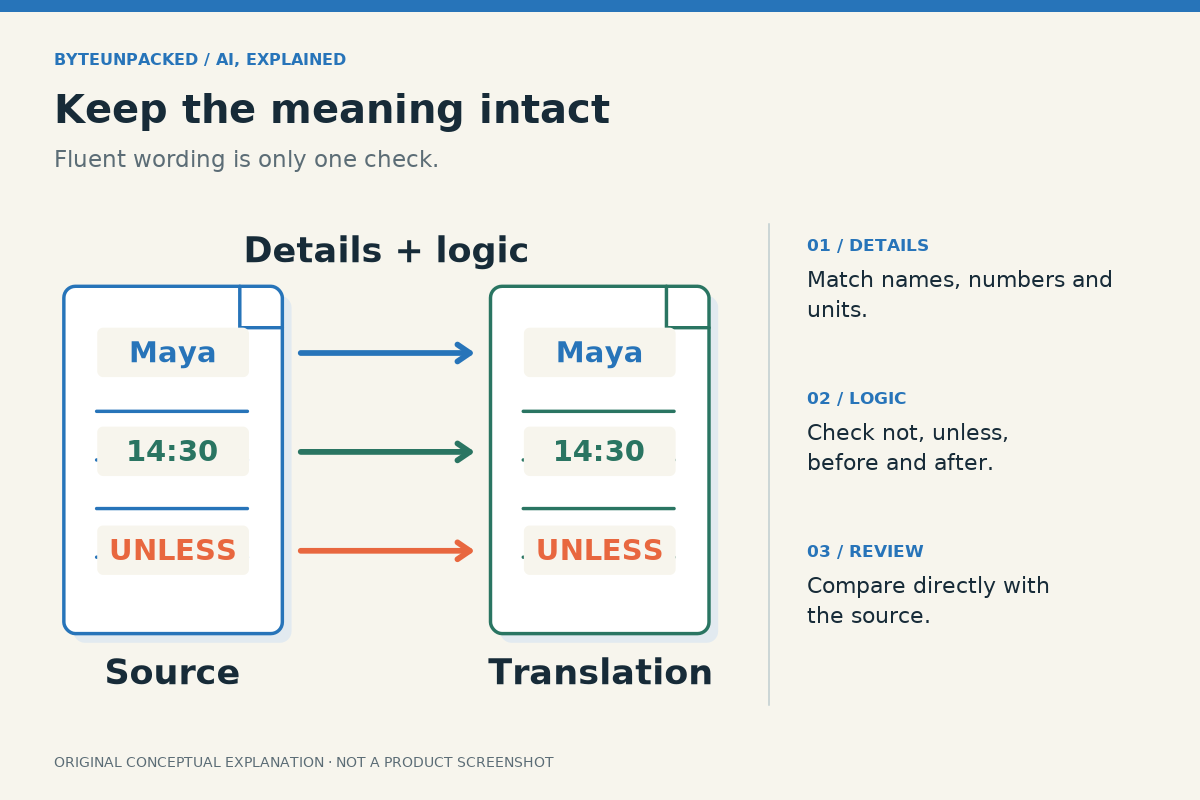
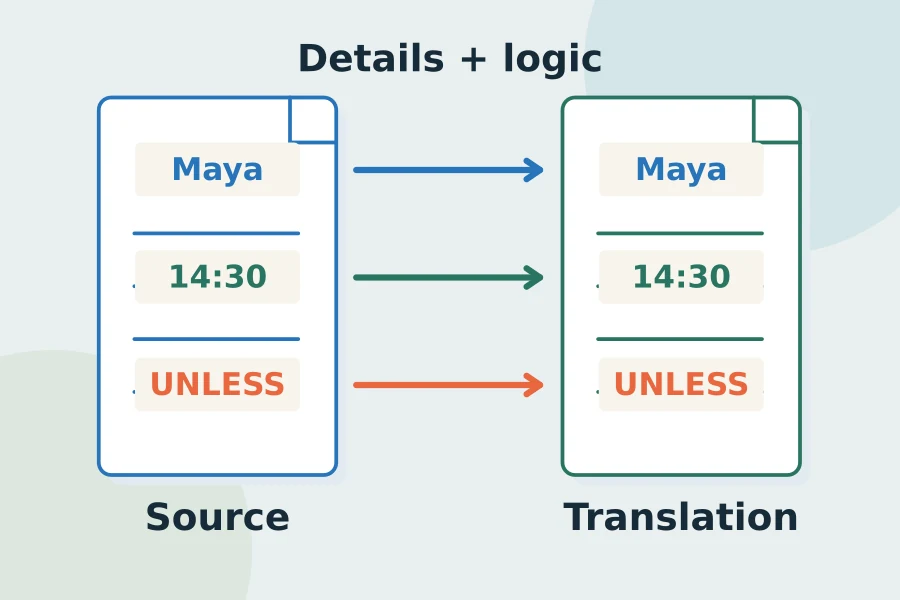
Use a second pass for words that change an instruction: not, only, unless, before, after, at least, and no more than. Consider this invented source sentence: Do not cancel the 14:30 booking unless Maya confirms. A translation can preserve the name and time while changing who must confirm, whether cancellation is allowed, or which event has to happen first.
For each important sentence, identify the actor, action, condition, and deadline in the original. Ask a reviewer who understands both languages to identify those same elements in the translated version. This gives the review a concrete task beyond deciding whether the phrasing sounds natural.
Watch qualifiers too. May be delayed and will be delayed express different levels of certainty. A useful translation preserves uncertainty and exceptions rather than making the message sound more decisive than the source.
Give the reviewer a small comparison checklist
For the booking example, your checklist could have four entries: the reservation is at 14:30, the instruction initially prohibits cancellation, Maya is the person who must confirm, and that confirmation changes whether cancellation is allowed. A bilingual reviewer can compare those entries with the translation and flag a specific mismatch without rewriting the entire message.
When a correction arrives, update the translation and check the surrounding sentence again. Changing a pronoun can affect which person an instruction refers to; moving a qualifying phrase can affect the action it limits. For repeated messages, keep the approved terminology and recurring instructions together so each new translation starts from the same reviewed wording.
If no one available can verify the target language, record what remains uncertain. A second AI opinion can help identify a question for review, but agreement between generated versions should not become your only reason for accepting a consequential instruction.
Use the translation for the level of confidence you have
You can ask an AI to highlight uncertain terms or explain a sentence, but that remains another generated answer. Translating the result back into the original language may reveal a discrepancy; a matching back-translation does not establish that every detail of the first translation is correct. Keep both texts available for direct comparison.
Microsoft's guidance recommends human review for consequential uses and notes that reviewers bring subject knowledge and sensitivity to context and tone. Arrange qualified review when a mistake could affect medical care, legal rights, or another serious decision. For a routine message, resolve the important details and consider asking the recipient to confirm the action and time in their own words.
Finish by reading the translated version as the recipient will see it. Check that line breaks, labels, links, and numbers still belong together. Save the reviewed translation alongside its source so a later edit can be checked against the same wording.
Sources & further reading
This is a source-based explainer, prepared with AI assistance and checked against the references above. It is not a hands-on product test. Read our editorial approach.